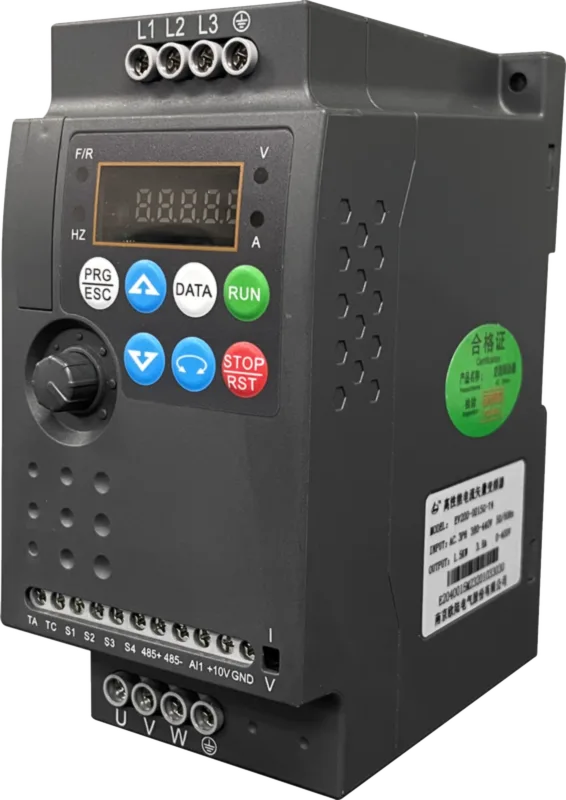


EV200-0004G-S2: Kompakter Einphasen-VFD | 0,4kW, 220V
Why Choose This 0.4 kW (0.5HP) 220V Single Phase VFD?
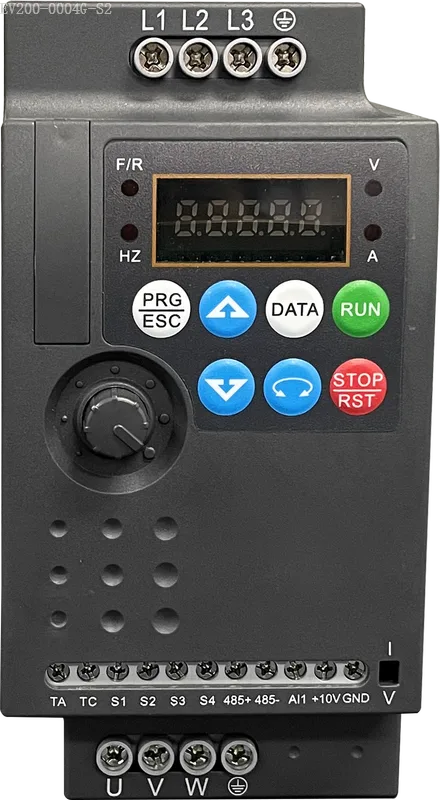
Choosing the right drive is crucial for performance and reliability. This specific 0.4 kW (0.5HP) VFD is the ultimate space-saver and the ideal choice for straightforward applications.
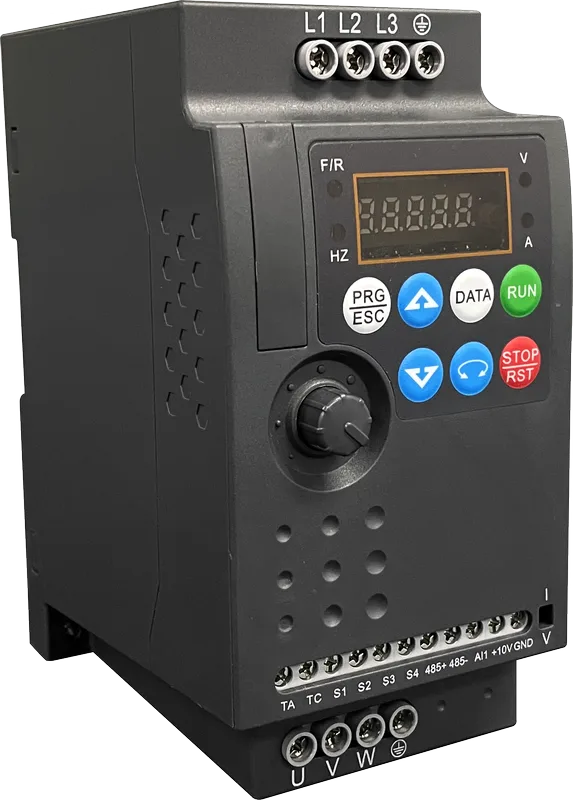
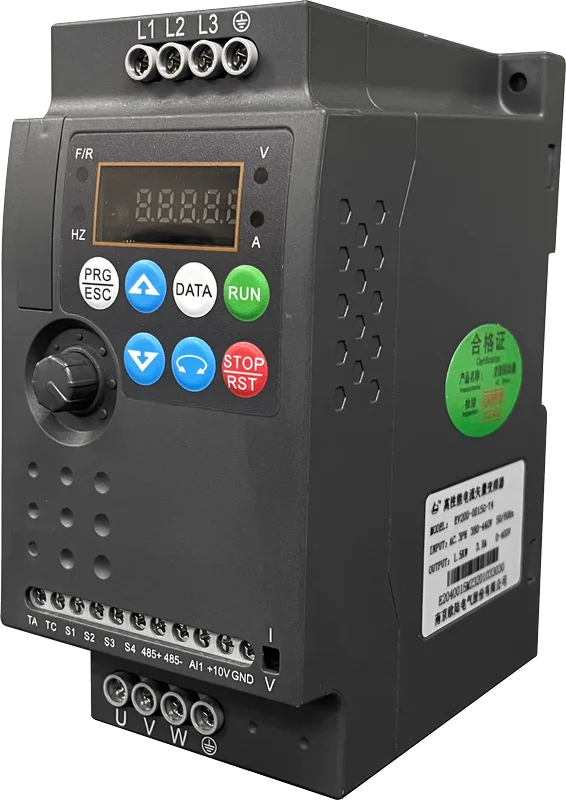
Designed for Tight Spaces: Its key feature is the ultra-compact narrow body design, which is 45% smaller than previous models. It also supports side-by-side installation, making it perfect for crowded control cabinets where space is a premium.
Simple and Efficient: While the EV510A series offers complex, high-count I/O, the EV200 is designed for simple speed regulation. Its streamlined 4 DI / 1 AI / 1 Relay setup provides all the necessary control for small automated machinery without unnecessary complexity or cost.
Reliable Vector Performance: Despite its small size, it delivers true vector control performance, providing excellent low-speed high-torque (150% at 0.5Hz) for reliable startups, far surpassing simple V/F control.
No Braking Unit: This model does not include a built-in braking unit, as it is part of the 0.75-2.2kW range, which is designed without them, making it a cost-effective choice for applications that do not require rapid deceleration.
Typische Anwendungsbereiche

Woodworking Machinery
A perfect compact VFD for wood carving machines (engraving machines) and small spindles.
Glass & Ceramic
Provides precision speed control for glass edging machines and small grinders.
Textile Industry
Simple speed control for small textile machines and winders.



Merkmale der Kontrolle
Kontrollmodus | ohne PG-Vektor (SVC), U/f-Steuerung |
|---|---|
Höchste Frequenz | Vektorsteuerung: 0~500Hz; V/F-Steuerung: 0~500Hz |
Startdrehmoment | Typ G: 0,5Hz/150% (SVC) |
Geschwindigkeitsbereich | 1:100 (SVC) |
Genauigkeit der Geschwindigkeitskontrolle | ±0,5% (SVC) |
Überlastbarkeit | Typ G: 150% Nennstrom 60s; 180% Nennstrom 3s |
E/A-Spezifikationen
Digitaler Eingang | 4 digitale Eingangsklemmen |
|---|---|
Analoger Eingang | 1 Analogeingangsklemme |
Relaiskontakt | 1 Relaisausgangsklemme |
Kommunikation | Unterstützt Modbus, RS85 (vorausgesetzt RS485), CANopen, CANlink |
Betriebsumgebung
Aufstellungsort | In Innenräumen, kein direktes Sonnenlicht, kein Staub, keine korrosiven Gase usw. |
|---|---|
Höhenlage | Weniger als 1000 Meter |
Temperatur in der Umgebung | -10°C bis +40°C (Leistungsreduzierung für 40~50°C erforderlich) |
Luftfeuchtigkeit | <95%RH, keine Kondensation |
Strukturelle Abmessungen
Abmessungen (B x T x H) | 73 x 112,6 x 143 mm |
|---|---|
Einbaumaße (A x B) | 60 x 129 mm |
Einbauloch | Ф4.4 |
Qualitätssicherung
Dieses Produkt wird von Nanjing Oulu Electric Corp. entwickelt und hergestellt. Als nationales Hightech-Unternehmen mit den Schwerpunkten Industrieautomation und neue Energien verfügen wir über ein erfahrenes Forschungs- und Entwicklungsteam und fortschrittliche Produktionsanlagen, um unseren Kunden weltweit hochwertige und zuverlässige Produkte und Lösungen zu bieten.
Häufig gestellte Fragen (FAQ)
1. Was ist der Unterschied zwischen V/F-Regelung und sensorloser Vektorregelung (SVC)?
V/F control is a basic method for motor speed regulation. Sensorless Vector Control (SVC) is more advanced, providing precise speed and torque control. The EV200 uses SVC to deliver high starting torque (150% at 0.5Hz), which is much better for starting loads than basic V/F.
2. Does the EV200-0004G-S2 have a built-in braking unit?
No. The EV200 series states that models from 0.75kW to 2.2kW do not have a built-in braking unit, and this 0.4kW model follows that design. An external braking resistor would be required for applications needing fast deceleration.
3. What is the key difference between the EV200 and EV510A series?
The EV200 is designed for simple speed regulation and ultra-compact size, featuring a narrow body that is 45% smaller and allows side-by-side installation. Its I/O is simplified (4 DI, 1 AI, 1 Relay). The EV510A series is a higher-performance drive with a much larger, more flexible I/O (7 DI, 2 AI, 2 AO, 2 Relay) for more complex automation tasks.
4. Can this VFD be installed in a small cabinet with other drives?
Yes. The EV200 features independent air ducts for efficient cooling and is specifically designed to be installed side-by-side with other units, making it ideal for saving space in power distribution cabinets.
Schnellstart-Anleitung (How-To)
Warnung: The following steps are a basic guide only. All electrical work must be performed by qualified professional personnel. Before any wiring, ensure the main power is completely disconnected and wait at least 10 minutes for the internal capacitors of the VFD to discharge fully.
Schritt 1: Installation
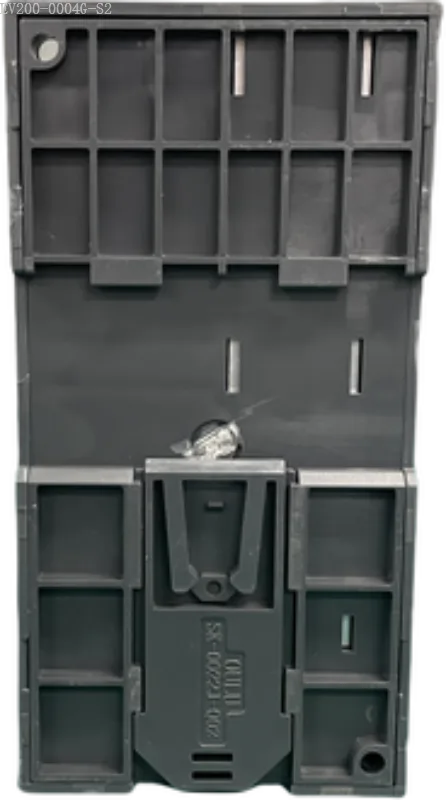
Mount the inverter vertically on a sturdy, non-flammable surface, such as a metal mounting plate. Ensure there is sufficient clearance for heat dissipation. Side-by-side installation is permitted.
Schritt 2: Verdrahtung des Hauptstromkreises
Verbinden Sie die einphasig 220V AC-Netzleitungen zu den Eingangsklemmen des Wechselrichters
R/L1undS/L2.Schließen Sie die drei Drähte des Drehstrom-Asynchronmotors an die Ausgangsklemmen des Umrichters an
U,V, undW.Verbinden Sie das Erdungskabel sicher mit dem Erdungsanschluss des Wechselrichters.
PE(Schutzerde) Anschluss.
Schritt 3: Verdrahtung des Steuerkreises (für einfachen Start/Stopp)
Schließen Sie ein Ende eines externen Schalters (oder Tasters) an den digitalen Eingangsanschluss an.
S1.Connect the other end of the switch to the
COMterminal.Parameter einstellen
P0-02(Auswahl der Befehlsquelle) auf “1” (Terminal-Befehlskanal).Parameter einstellen
P4-00(S1 Funktionswahl) auf “1” (Vorwärtslauf).
Schritt 4: Einstellung der Motorparameter und Auto-Tuning
Geben Sie beim ersten Einschalten die folgenden Parameter vom Typenschild Ihres Motors genau ein:
P1-01: Motor-Nennleistung (eingestellt auf 0,4kW)P1-02: Motornennspannung (eingestellt auf 220V)P1-03: Motor Rated Current (e.g., 2.3A)P1-04: Nennfrequenz des MotorsP1-05: Motor Nenndrehzahl
Um eine optimale Leistung der Vektorsteuerung zu erreichen, führen Sie eine automatische Motorabstimmung durch. Parameter einstellen
P1-37(Motor auto-tuning) to “2” (dynamic auto-tuning) or “3” (static auto-tuning) and start the inverter.
Schritt 5: Testlauf
Nachdem Sie sich vergewissert haben, dass alle Verdrahtungen und Parametereinstellungen korrekt sind, schalten Sie die Hauptstromversorgung ein. Schließen Sie den externen Schalter, der zwischen S1 und COM. Der Motor sollte beginnen, sich in Vorwärtsrichtung zu drehen. Öffnen Sie den Schalter, und der Motor wird entsprechend der eingestellten Verzögerungszeit angehalten.
Hauptmerkmale und Vorteile
Ultra-Compact Narrow Body: Features a new narrow body design and compact structure. Compared to older products, the installation size is reduced by 30% and the volume by 45%, saving installation space and reducing distribution costs.
Space-Saving Installation: The design features independent air ducts for efficient, straight-through heat dissipation, which allows for side-by-side installation to maximize use of cabinet space.
High Starting Torque: This AC motor drive is capable of 0.5Hz starting torque at 150% under Sensorless Vector Control (SVC), providing excellent low-speed performance for general-purpose loads.
Robust Overload Capacity: As a G-type drive, it handles 150% of its rated current for 60 seconds and 180% for 3 seconds, ensuring stability during load changes.
Simplified I/O: Designed for simple speed regulation, this model features a streamlined I/O configuration of 4 digital input terminals, 1 analog input, and 1 relay output.
Smart Integrated Functions: Includes a built-in PID controller for process control, a Simple PLC for multi-stage speed running, and Auto-adjust voltage (AVR) to keep output voltage steady when the grid voltage changes.
Datei | Größe | Aktion |
|---|---|---|
VFD-Auswahlhilfe.pdf | 4.2MB | |
VFD EV200 Benutzerhandbuch.pdf | 1.4MB |