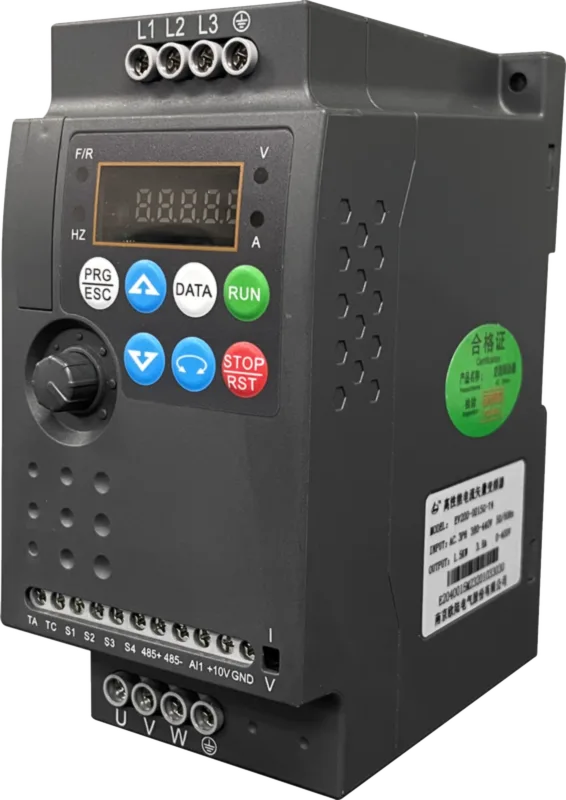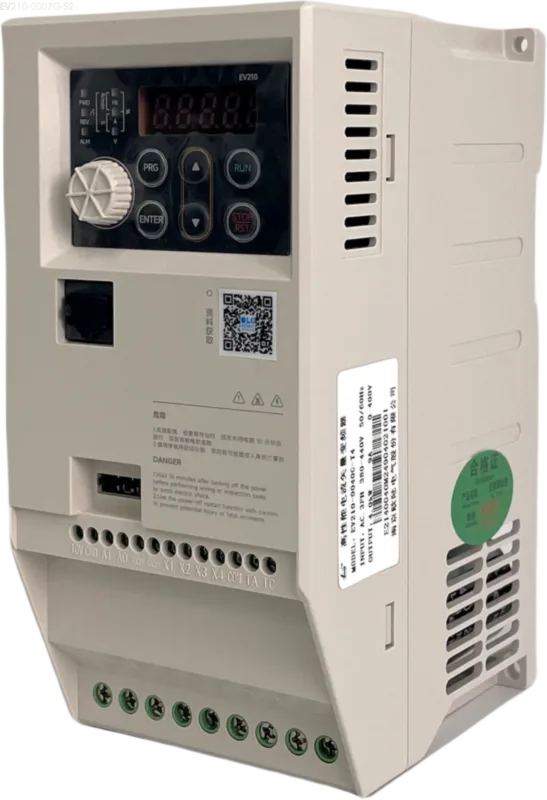


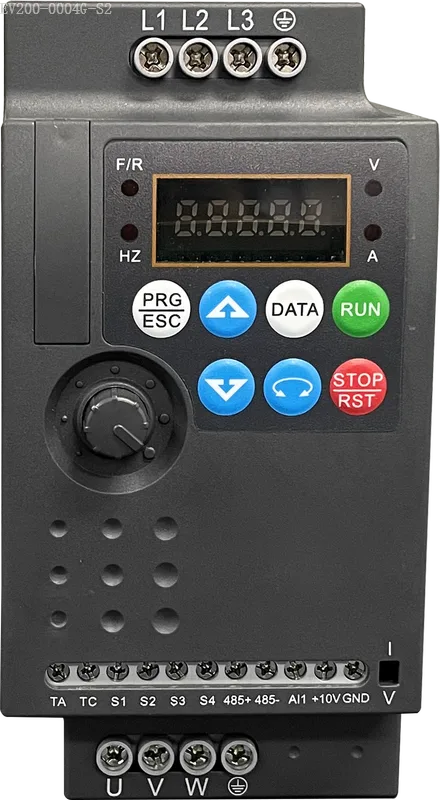
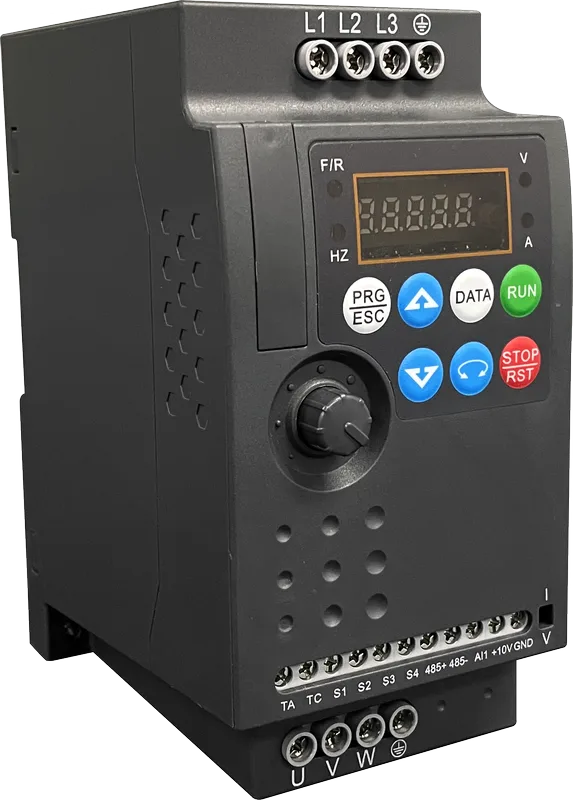
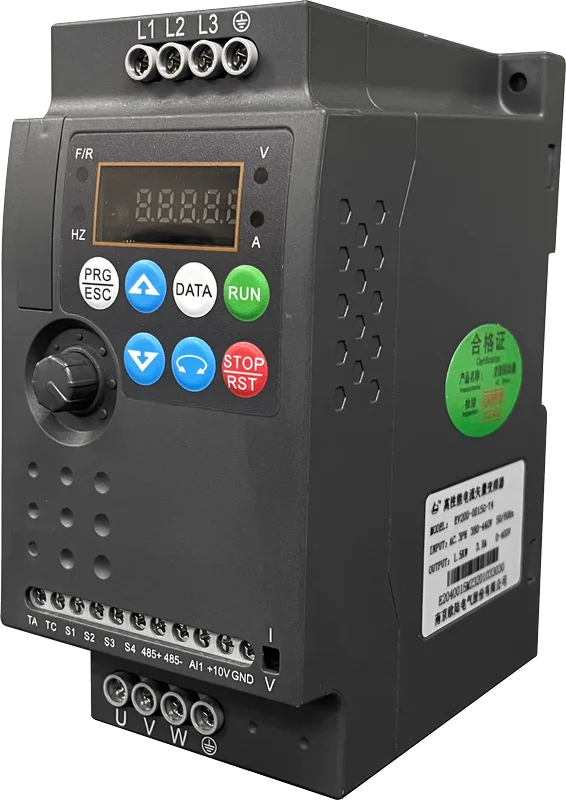
EV200-0004G-S2 : VFD compact monophasé - 0.4kW, 220V
Why Choose This 0.4 kW (0.5HP) 220V Single Phase VFD?
Choosing the right drive is crucial for performance and reliability. This specific 0.4 kW (0.5HP) VFD is the ultimate space-saver and the ideal choice for straightforward applications.
Designed for Tight Spaces: Its key feature is the ultra-compact narrow body design, which is 45% smaller than previous models. It also supports side-by-side installation, making it perfect for crowded control cabinets where space is a premium.
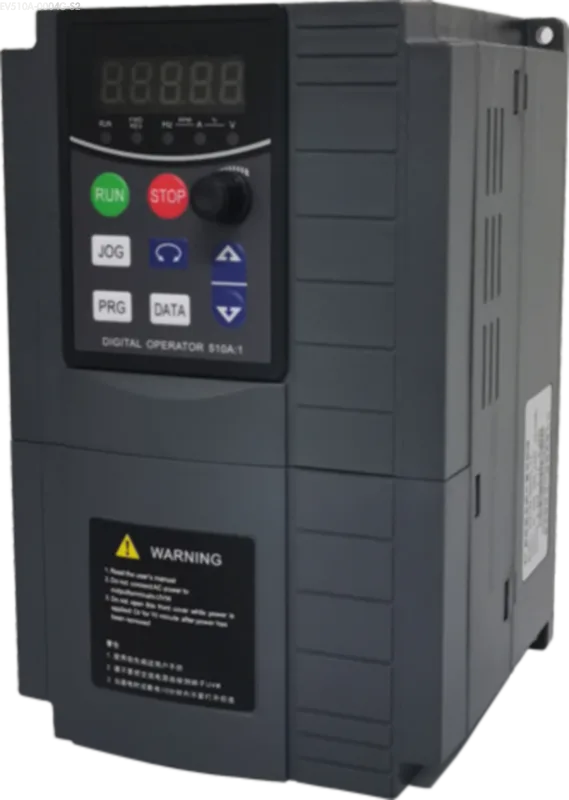
Simple and Efficient: While the EV510A series offers complex, high-count I/O, the EV200 is designed for simple speed regulation. Its streamlined 4 DI / 1 AI / 1 Relay setup provides all the necessary control for small automated machinery without unnecessary complexity or cost.
Reliable Vector Performance: Despite its small size, it delivers true vector control performance, providing excellent low-speed high-torque (150% at 0.5Hz) for reliable startups, far surpassing simple V/F control.
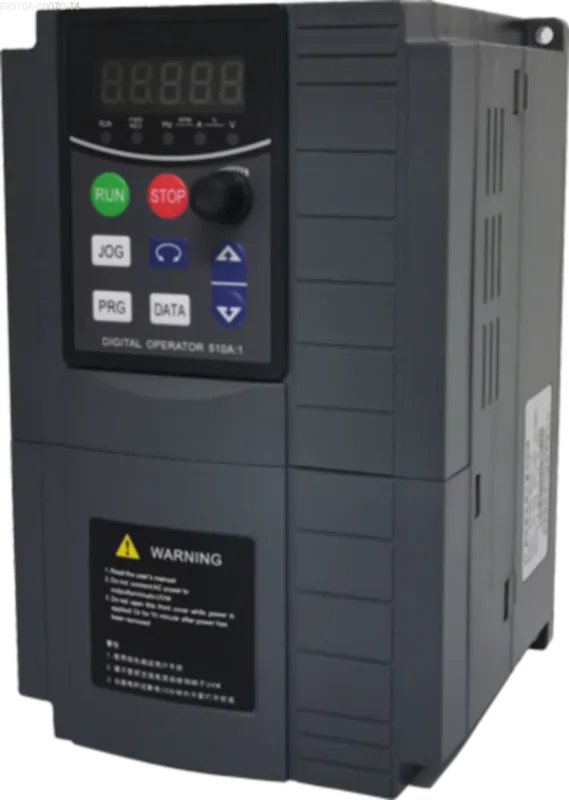
No Braking Unit: This model does not include a built-in braking unit, as it is part of the 0.75-2.2kW range, which is designed without them, making it a cost-effective choice for applications that do not require rapid deceleration.
Domaines d'application typiques

Woodworking Machinery
A perfect compact VFD for wood carving machines (engraving machines) and small spindles.
Glass & Ceramic
Provides precision speed control for glass edging machines and small grinders.
Textile Industry
Simple speed control for small textile machines and winders.



Caractéristiques de contrôle
Mode de contrôle | sans vecteur PG (SVC), contrôle V/F |
|---|---|
Fréquence la plus élevée | Contrôle vectoriel : 0~500Hz ; contrôle V/F : 0~500Hz |
Couple de démarrage | Type G : 0,5Hz/150% (SVC) |
Gamme de vitesse | 1:100 (SVC) |
Précision du contrôle de la vitesse | ±0,5% (SVC) |
Capacité de surcharge | Type G : 150% courant nominal 60s ; 180% courant nominal 3s |
Spécifications E/S
Entrée numérique | 4 bornes d'entrée numérique |
|---|---|
Entrée analogique | 1 borne d'entrée analogique |
Sortie relais | 1 borne de sortie de relais |
Communication | Prend en charge Modbus, RS85 (supposé RS485), CANopen, CANlink |
Environnement opérationnel
Site d'installation | A l'intérieur, pas de lumière directe du soleil, pas de poussière, de gaz corrosifs, etc. |
|---|---|
Altitude | En dessous de 1000 mètres |
Température ambiante | -10°C à +40°C (déclassement nécessaire pour 40~50°C) |
Humidité | <95%RH, pas de condensation |
Dimensions structurelles
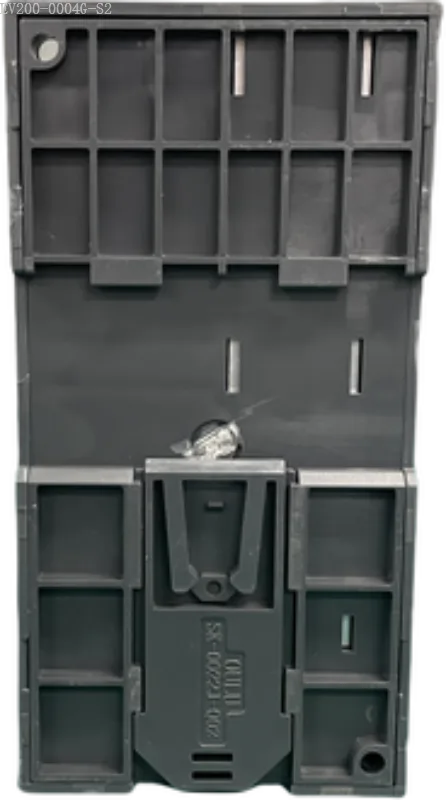
Dimensions (L x P x H) | 73 x 112,6 x 143 mm |
|---|---|
Taille de l'installation (A x B) | 60 x 129 mm |
Trou d'installation | Ф4.4 |
Assurance qualité
Ce produit est développé et fabriqué par Nanjing Oulu Electric Corp, Ltd. En tant qu'entreprise nationale de haute technologie spécialisée dans l'automatisation industrielle et les nouvelles énergies, nous disposons d'une équipe de R&D expérimentée et d'installations de production de pointe, qui se consacrent à la fourniture de produits et de solutions fiables et de haute qualité à des clients du monde entier.
Foire aux questions (FAQ)
1. Quelle est la différence entre la commande V/F et la commande vectorielle sans capteur (SVC) ?
V/F control is a basic method for motor speed regulation. Sensorless Vector Control (SVC) is more advanced, providing precise speed and torque control. The EV200 uses SVC to deliver high starting torque (150% at 0.5Hz), which is much better for starting loads than basic V/F.
2. Does the EV200-0004G-S2 have a built-in braking unit?
No. The EV200 series states that models from 0.75kW to 2.2kW do not have a built-in braking unit, and this 0.4kW model follows that design. An external braking resistor would be required for applications needing fast deceleration.
3. What is the key difference between the EV200 and EV510A series?
The EV200 is designed for simple speed regulation and ultra-compact size, featuring a narrow body that is 45% smaller and allows side-by-side installation. Its I/O is simplified (4 DI, 1 AI, 1 Relay). The EV510A series is a higher-performance drive with a much larger, more flexible I/O (7 DI, 2 AI, 2 AO, 2 Relay) for more complex automation tasks.
4. Can this VFD be installed in a small cabinet with other drives?
Yes. The EV200 features independent air ducts for efficient cooling and is specifically designed to be installed side-by-side with other units, making it ideal for saving space in power distribution cabinets.
Guide de démarrage rapide (How-To)
Avertissement : The following steps are a basic guide only. All electrical work must be performed by qualified professional personnel. Before any wiring, ensure the main power is completely disconnected and wait at least 10 minutes for the internal capacitors of the VFD to discharge fully.
Étape 1 : Installation
Mount the inverter vertically on a sturdy, non-flammable surface, such as a metal mounting plate. Ensure there is sufficient clearance for heat dissipation. Side-by-side installation is permitted.
Étape 2 : Câblage du circuit principal
Connecter le monophasé 220V Lignes d'alimentation en courant alternatif vers les bornes d'entrée de l'onduleur
R/L1etS/L2.Connecter les trois fils du moteur asynchrone triphasé aux bornes de sortie du variateur.
U,V, etW.Connectez fermement le fil de terre à la prise de terre de l'onduleur.
PE(terre de protection).
Étape 3 : Câblage du circuit de commande (pour le démarrage/arrêt de base)
Connecter une extrémité d'un interrupteur externe (ou d'un bouton) à la borne d'entrée numérique.
S1.Connect the other end of the switch to the
COMterminal.Paramètre défini
P0-02(Sélection de la source de commande) à “1” (Canal de commande du terminal).Paramètre défini
P4-00(sélection de la fonction S1) à “1” (marche avant).
Étape 4 : Paramétrage du moteur et réglage automatique
Lors de la première mise sous tension, entrez avec précision les paramètres suivants de la plaque signalétique de votre moteur :
P1-01: Puissance nominale du moteur (réglée sur 0,4 kW)P1-02: Tension nominale du moteur (réglée sur 220V)P1-03: Motor Rated Current (e.g., 2.3A)P1-04: Fréquence nominale du moteurP1-05: Vitesse nominale du moteur
Pour une performance optimale de la commande vectorielle, effectuez un auto-réglage du moteur. Régler le paramètre
P1-37(Motor auto-tuning) to “2” (dynamic auto-tuning) or “3” (static auto-tuning) and start the inverter.
Étape 5 : Test de fonctionnement
Après avoir vérifié que le câblage et les paramètres sont corrects, mettez l'appareil sous tension. Fermez l'interrupteur externe connecté entre S1 et COM. Le moteur doit commencer à tourner dans le sens de la marche. Ouvrez l'interrupteur et le moteur s'arrêtera en fonction du temps de décélération défini.
Caractéristiques principales et avantages
Ultra-Compact Narrow Body: Features a new narrow body design and compact structure. Compared to older products, the installation size is reduced by 30% and the volume by 45%, saving installation space and reducing distribution costs.
Space-Saving Installation: The design features independent air ducts for efficient, straight-through heat dissipation, which allows for side-by-side installation to maximize use of cabinet space.
High Starting Torque: This AC motor drive is capable of 0.5Hz starting torque at 150% under Sensorless Vector Control (SVC), providing excellent low-speed performance for general-purpose loads.
Robust Overload Capacity: As a G-type drive, it handles 150% of its rated current for 60 seconds and 180% for 3 seconds, ensuring stability during load changes.
Simplified I/O: Designed for simple speed regulation, this model features a streamlined I/O configuration of 4 digital input terminals, 1 analog input, and 1 relay output.
Smart Integrated Functions: Includes a built-in PID controller for process control, a Simple PLC for multi-stage speed running, and Auto-adjust voltage (AVR) to keep output voltage steady when the grid voltage changes.
Fichier | Taille | Action |
|---|---|---|
Guide de sélection des VFD.pdf | 4.2MB | |
VFD EV200 Manuel de l'utilisateur.pdf | 1.4MB |