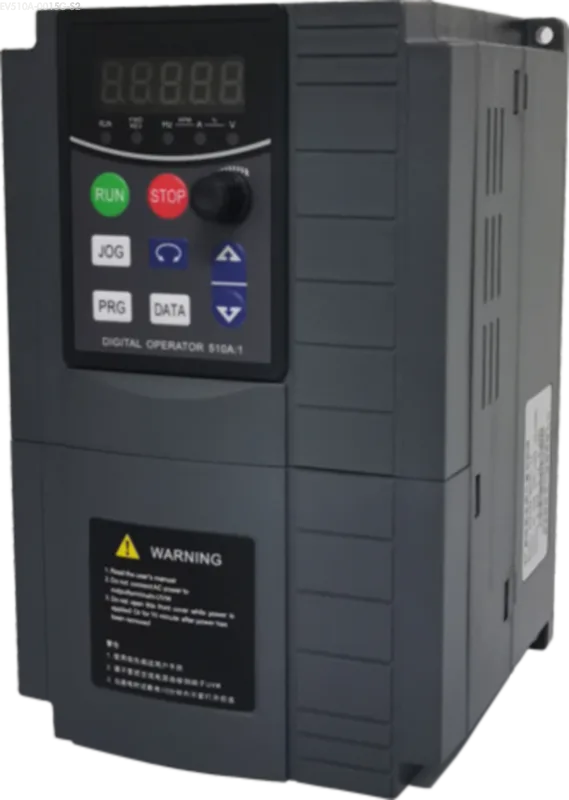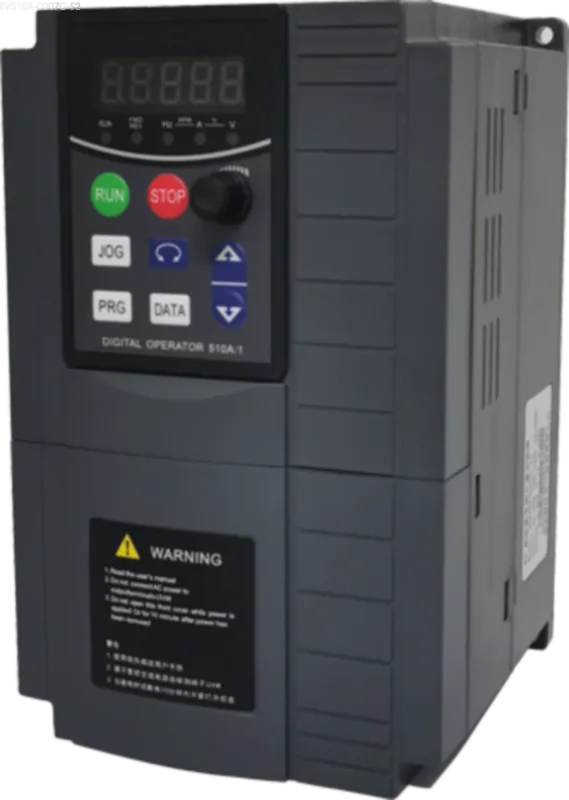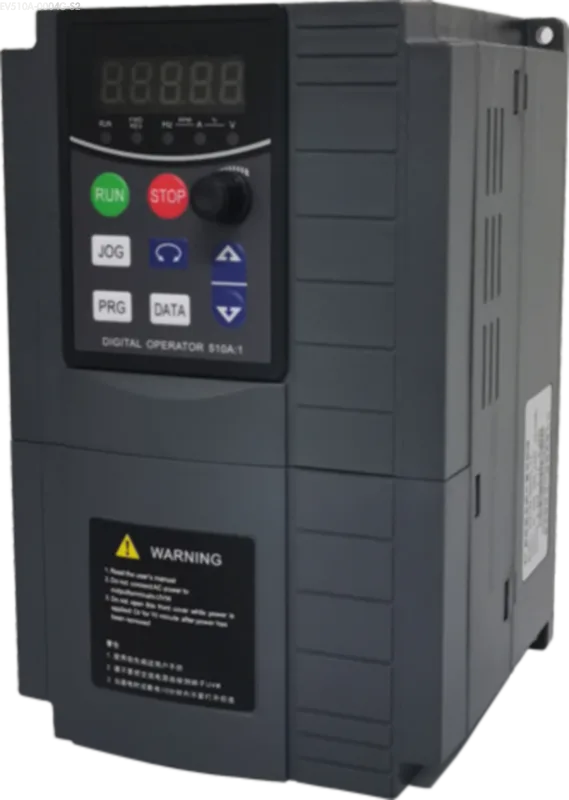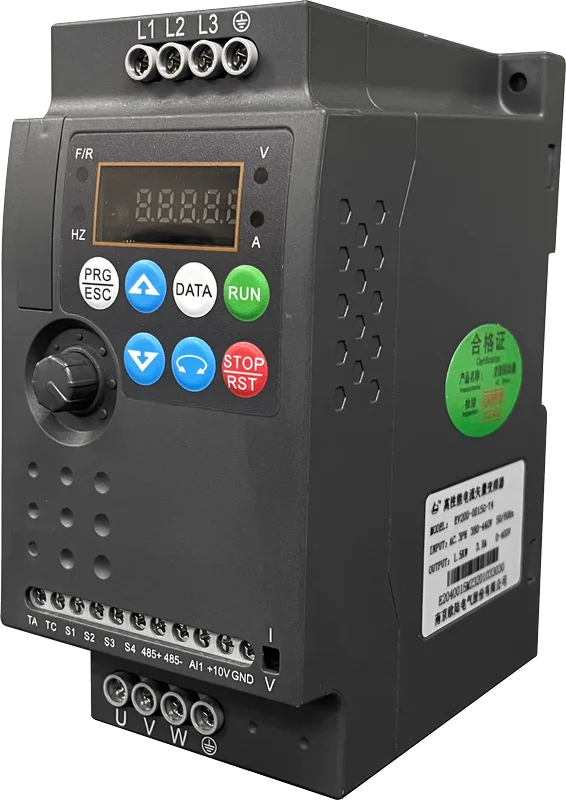


EV210-0004G-S2 : VFD vectoriel compact à haute performance | 0,4kW, 220V
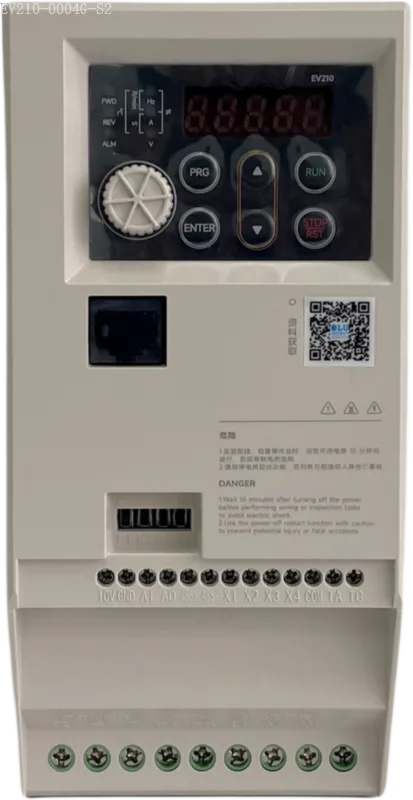
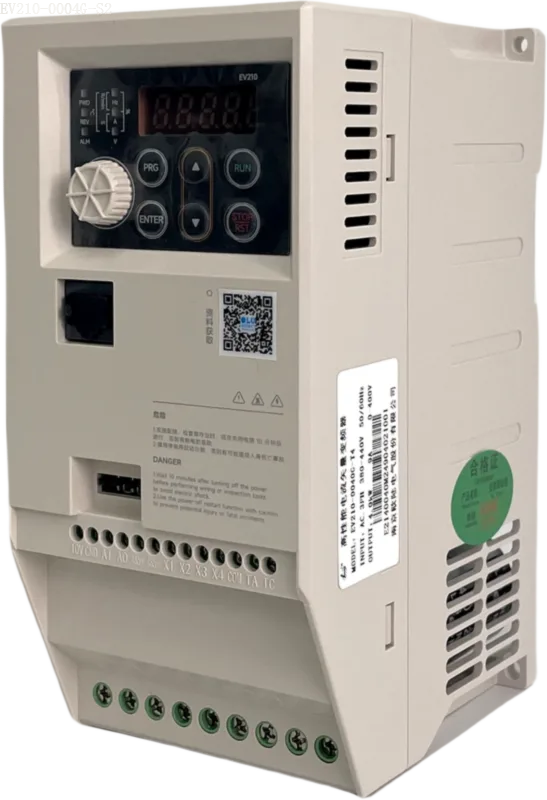
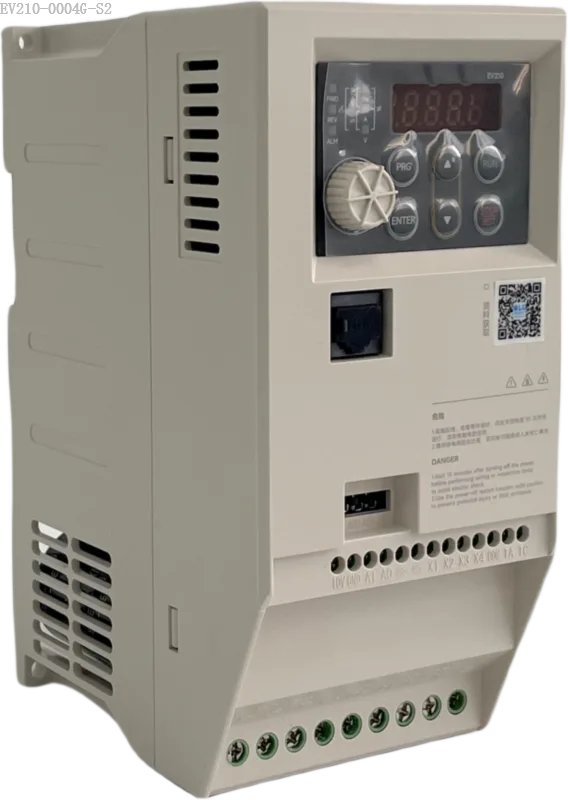
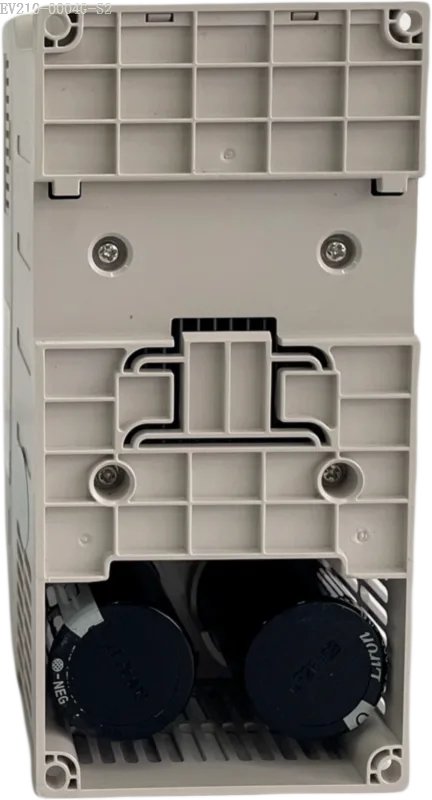
Why Choose This 0.4kW (0.5HP) 220V Compact Vector VFD?
Choosing the right drive is critical. This specific 0.4kW (0.5HP) VFD is the ideal solution when your application is too demanding for a basic mini-drive, but the installation space is too small for a full-sized vector drive.
- The “Compact Vector” Hybrid Advantage: This is the perfect hybrid drive. When a basic miniature AC drive (like the EV200, designed for “simple speed regulation” ) lacks the precision for your load, the EV210-0004G-S2 provides the advanced vector control you need in the compact form factor you want.
- Precision for Complex Micro-Machinery: This AC motor speed controller excels in applications beyond simple fans. Its vector control is essential for machines-outils , enrouleurs de textiles , ou machines d'emballage où le moteur doit maintenir une vitesse et un couple exacts sous des charges variables.
- Quiet, Reliable Operation: The adjustable carrier frequency provides low noise operation , a critical feature for equipment installed in noise-sensitive environments like laboratories or small workshops.
- Cost-Effective Automation: By integrating PID and RS485 communication , this compact vector VFD can simplify your system design, eliminating the need for external controllers and reducing total system cost and complexity.
Domaines d'application typiques

Machines textiles
A perfect textile machine VFD for small winders, spinning frames, and knitting machines requiring precise tension and speed synchronization in a compact form factor.
CNC & Machine Tools
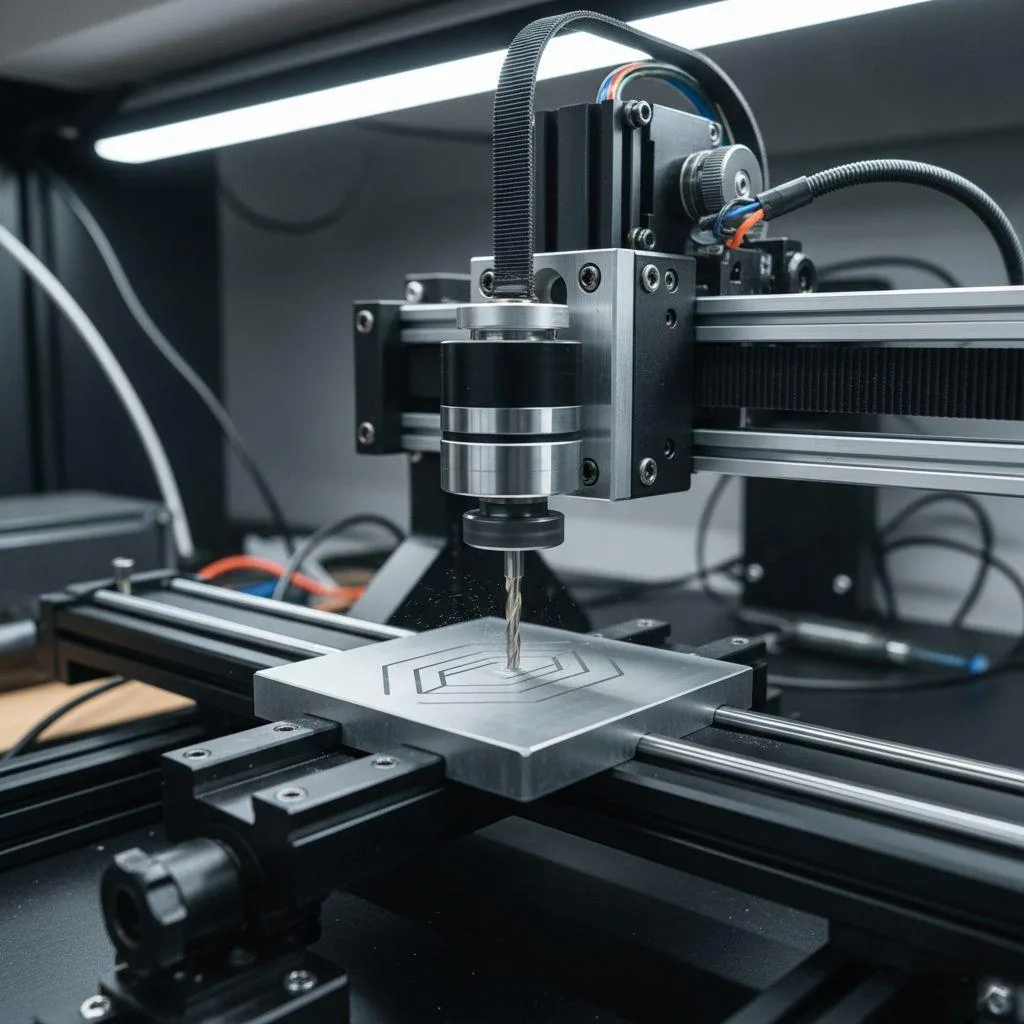
Provides the precise sensorless vector control needed for CNC engraving spindles, small machine tools , grinders, and lathes that require stable torque across their speed range.
Laboratory & Medical
Its low noise operation and precision make it suitable for medical centrifuges or advanced laboratory mixers and samplers.


Caractéristiques de contrôle
Mode de contrôle | Contrôle vectoriel de courant haute performance, contrôle vectoriel sans capteur (SVC), contrôle V/F |
|---|---|
Fréquence la plus élevée | Contrôle vectoriel : 0~500Hz ; Contrôle V/F : 0~500Hz |
Fréquence porteuse | 0,5KHz ~ 16,0KHz (réglable, pour un fonctionnement à faible bruit) |
Suivi de la vitesse | Fonction “suivi de la vitesse” Fonction de redémarrage de la vitesse” |
Freinage en courant continu | Fréquence de démarrage : 0.00 ~ Max Freq ; Temps de freinage : 0.0 ~ 100.0s |
Temps d'accélération/décélération | 0,0s ~ 6500,0s |
Spécifications E/S
Entrée analogique | 1 canal (0~10V / 0~20mA) |
|---|---|
Sortie analogique | 1 canal (0~10V / 0~20mA) |
Sortie numérique | 1 sortie relais programmable (TA, TC) |
Communication | Standard RS-485 (Modbus) |
Environnement opérationnel
Site d'installation | A l'intérieur, pas de lumière directe du soleil, pas de poussière, de gaz corrosifs, etc. |
|---|---|
Altitude | En dessous de 1000 mètres |
Température ambiante | De -10°C à +40°C |
Humidité | <95%RH, pas de condensation |
Dimensions structurelles
Dimensions (L x P x H) | 72 x 105 x 146 mm |
|---|---|
Taille de l'installation (A x B) | 63,0 x 136,5 mm |
Trou d'installation | φ2.3 |
Assurance qualité
Ce produit est développé et fabriqué par Nanjing Oulu Electric Corp, Ltd. En tant qu'entreprise nationale de haute technologie spécialisée dans l'automatisation industrielle et les nouvelles énergies, nous disposons d'une équipe de R&D expérimentée et d'installations de production de pointe, qui se consacrent à la fourniture de produits et de solutions fiables et de haute qualité à des clients du monde entier.
Foire aux questions (FAQ)
1. What is the main difference between the 0.4kW EV210 and the 0.4kW EV200 VFD?
The key difference is the control method and positioning. The EV200 is a “small inverter” designed for régulation simple de la vitesse. The EV210 is a “high-performance miniature inverter” that integrates advanced current vector control. Choose the EV200 for simple applications like small fans or basic conveyors. Choose the EV210 for applications needing precise speed, high starting torque, or stable control under load, such as machine tools or packaging.
2. Can I use this 0.4kW VFD for a CNC or machine tool spindle motor?
Yes, the EV210-0004G-S2 is an excellent choice for small machine tool spindles. Its sensorless vector control provides stable torque even at low speeds, which is crucial for cutting. Furthermore, its adjustable high-carrier frequency (up to 16.0KHz) ensures low noise operation , reducing the “whine” from the motor.
3. What is the benefit of the ‘speed tracking restart’ function?
This function allows the VFD to smoothly “catch” a motor that is already spinning (e.g., a fan coasting after a brief power outage) and return it to the set speed without a harsh start or tripping on overcurrent. This is critical for reliable, uninterrupted operation in automated systems.
4. How does the built-in PID controller work?
The built-in PID allows the VFD to automatically regulate motor speed to maintain a process variable. For example, you can connect a pressure sensor (as an analog input) and set a target pressure. The VFD will then speed up or slow down a small pump to perfectly maintain that pressure, all without needing an external PLC.
Guide de démarrage rapide (How-To)
Avertissement : Les étapes suivantes ne constituent qu'un guide de base. Tous les travaux électriques doivent être effectués par du personnel professionnel qualifié. Avant tout câblage, assurez-vous que l'alimentation principale est complètement déconnectée et attendez au moins 10 minutes pour que les condensateurs internes de l'entraînement à fréquence variable se déchargent complètement.
Étape 1 : Installation
Mount the VFD vertically on a sturdy, non-flammable surface (like a metal backplate) or a DIN rail in a well-ventilated cabinet. Ensure sufficient clearance for airflow. The compact 72mm width allows for high-density, side-by-side installation.
Étape 2 : Câblage du circuit principal
- Connectez vos lignes électriques monophasées 220V AC aux bornes d'entrée de l'onduleur S/L1 et T/L2.
- Connect the three wires of your 0.4kW (0.5HP) three-phase asynchronous motor to the inverter’s output terminals U, V, and W.
- Raccordez fermement le fil de terre à la borne PE (terre de protection) de l'onduleur.
Étape 3 : Câblage du circuit de commande (pour le démarrage/arrêt de base à 2 fils)
- Connectez une extrémité d'un interrupteur externe (ou d'un bouton) à la borne d'entrée numérique X1.
- Connecter l'autre extrémité de l'interrupteur à la borne commune COM.
- (This setup uses X1 for a simple “Run” command in 2-wire mode).
Étape 4 : Paramétrage et configuration du moteur
- Lors de la première mise sous tension, réglez les paramètres du VFD pour qu'ils correspondent à la plaque signalétique de votre moteur :
- Set P1-01 (Motor Rated Power) to 0.4 (kW).
- Réglez P1-02 (Tension nominale du moteur) sur 220 (V).
- Réglez P1-03 (courant nominal du moteur) en fonction de la plaque signalétique de votre moteur.
- Réglez P1-04 (Fréquence nominale du moteur) (par exemple, 50 ou 60 Hz).
- Réglez P1-05 (vitesse nominale du moteur) (par exemple, 1440, 2800, etc.).
- Pour activer le démarrage/arrêt à 2 fils à partir de l'étape 3 :
- Set P0-02 (Command source) to “1” (Terminal command channel).
- Set P4-00 (X1 function selection) to “1” (Forward run).
- For optimal vector control performance, perform a motor auto-tune (set P1-37, see manual for details).
Étape 5 : Test de fonctionnement
Après avoir confirmé l'ensemble du câblage et des réglages, mettez l'appareil sous tension. Fermez l'interrupteur externe connecté entre X1 et COM. Le moteur doit démarrer et fonctionner en marche avant. Ouvrez l'interrupteur, le moteur décélère et s'arrête.
Caractéristiques principales et avantages
- Advanced Vector Control in a Miniature Body: This drive integrates a high-performance current vector inverter into a compact frame. It provides outstanding torque characteristics and precise speed control (SVC), far superior to standard V/F control , making it ideal for dynamic loads.
- Ultra-Compact, Space-Saving Design: Measuring only 72mm wide and 105mm deep , this miniature vector VFD is designed for high-density DIN-rail mounting in crowded control cabinets, saving space and reducing overall machine footprint.
- Quiet & Stable Performance: Engineered for low noise operation, the VFD features an adjustable carrier frequency (0.5KHz ~ 16.0KHz) to minimize high-frequency motor noise, making it suitable for laboratory or light commercial environments. The Automatic Voltage Control (AVR) function ensures stable performance even with grid fluctuations.
- Integrated PID & PLC Functions: Features a built-in PID controller and Easy PLC function, enabling simple closed-loop process control (e.g., managing pressure, flow) and basic multi-segment speed operation.
- Reliable System Protection: Offers comprehensive protection functions , including overcurrent, overvoltage, undervoltage, overheat, and overload. Includes a speed tracking restart function for a smooth, safe recovery from a momentary power loss.
- Flexible System Integration: Standard built-in RS485 communication (Modbus protocol) allows this 0.4kW VFD to be easily integrated into larger automation systems. Flexible I/O includes analog inputs (0-10V/0-20mA) and a programmable relay output.
Fichier | Taille | Action |
|---|---|---|
Guide de sélection des VFD.pdf | 4.2MB | |
VFD EV210 Manuel de l'utilisateur.pdf | 1.3MB |